20 February 2011

Eat Real Food


Is Monsanto Responsible For 200,000 Farmer Suicides?


"A recent study has found that 200,000 Indian farmers have killed themselves in the past ten years.


Well-known Bollywood filmaker Aamir Khan attributes this startling statistic to the fact that many unsuspecting farmers are convinced that genetically modified seeds, pesticides, and fertilizers from American companies like Monsanto will increase their profits. Khan is hoping to spread awareness about this disturbing trend in a new movie.


The film, called Peepli Live, is set in an Indian village named Peepli. A young debt-burdened farmer named Natha is talked into taking his own life after he learns that his family will be financially compensated through a government program created to alleviate the loss of farmers taking their own lives. See this link here.


To afford the supplies and steep licensing fees imposed by Monsanto, many farmers mortgage their farms just to survive to plant another year. The first bad yield due to drought or flooding plunges them so far into debt that many resort to suicide."


The above narrative was taken from this article.

The Problem With Franken-Food


Supporters of genetically engineered foods often claim that bio-crops are the only way to feed the world's booming population in the future.


However, a study from the Union of Concerned Scientists shows that genetically engineered crops have not been proven to produce larger harvests. Crop yield increases in recent years have almost entirely been due to improved farming or traditional plant breeding, despite thousands of field trials of GM crops.


To read a report about failure to increase yield go to this link here and to read the narrative, “Can Genetically Modified Crops Feed the World?” go to this link here


Seeds purchased from companies like Monsanto are also engineered with "terminator technology", which means plants produce sterile seeds after only one season. Farmers, already in debt because of the high price of "superior" GM seeds, are thereby forced to buy more seeds for the next harvest.


Arunachala Bird Population


Right Click on all photographs to view enlarged version.


All photographs included in this narrative are by Mr. Kumar, artist and bird watcher, and whose paintings can be viewed on the paths of the Mountain of Medicine at the foot of Arunachala.


Bird Population at Tiruvannamalai


Those involved in afforestation work around Arunachala, believe that there has been an increase in the number of species found on the Hill and surrounding forests primarily as a result of the enhanced food base which is resulting from the increased green cover of this area.

There is currently 120 species of birds estimated in this area compared to only 20-30 species found a decade ago in the forest surrounding Arunachala. Some of the recent arrivals are: Small Minivet, Sirkeer Malkoha, Lesser-Spotted Eagle Owls, Eurasian Eagle Owl, Mottled Wood Owl, Paradise Fly Catcher and the Black-Headed Cuckoo.

Common species such Mynah, Swifts, Swallows, Yellow Billed Babblers, Parrots and Indian Rollers (Blue Jays) are seen in large numbers in the forests surrounding Arunachala and also in the town of Tiruvannamalai and outskirts.


Other species such as Red-Vented Bulbuls, Robins, Coucals, Doves, Barbets, Shikra, Bee-Eaters, Sun Birds, Warblers can also be viewed in increasing numbers on the Hill and to a lesser extent, increasing sightings of Peacocks, Golden Oriole, Red Whiskered Bulbul and Koels are being recorded.


The District Forest Office has been ordered to take up a preliminary survey of birds and thereafter with the help of experts conduct a detailed survey of birds in the area.


A local artist and bird watcher Mr. Kumar mentions he has noticed increasingly larger numbers of: Common Wood Shrikes, Painted-Spur Fowls and Gray Francolins. With winter-visitors like Blue Rock Thrush, Pitta and Forest Wag Tail seen around Arunachala this season. Mr. Kumar attributes the growth of species to increase in forest cover, reduction of forest fires and a ban on hunting.


Mr. Kumar is currently engaged at the Mountain Of Medicine painting beautiful representations of the bird and wild life found at Arunachala. The paintings with supporting information are displayed on the paths of the Mountain of Medicine sanctuary which is located on the NH 66 Chengham Road, half a kilometre west of Raman Ashram. All are welcome.

[With thanks to A.D. Balasubramaniyan]

Garuda Mythology


As mentioned in a previous posting, the Brahminy Kite is worshipped as a representation of Garuda (the sacred Eagle and mount of Lord Vishnu). To read about the mythology of Garuda and to watch a video animation of the origin of the Garuda, check out this link here.


22 September 2010

Brahminy Kite

This bird (Tamil: Krishna Parunthu) is found at Tiruvannamalai, and there are several Brahminy Kite nests by Samudram Lake. Where the nests are known, the birds are worshipped as representative of Garuda (the sacred Eagle), but this bird is actually a Kite.

The Brahminy Kite (Haliastur indus) is also known as the Red Backed Sea Eagle and the Singapore Bald Eagle. It is a medium-sized bird of prey in the family Accipitridae, which also includes other diurnal raptors such as eagles, buzzards and harriers.


Locals at Samudram coming to glimpse
their sacred bird


The bird hoping the visitors have
brought chicken bits


The Brahminy Kite has long broad rounded wings; short and rounded tail when fanned. Its head, neck and breast are white with rest of its body bright chestnut and primaries tipped black and feet yellow. In flight it exhibits slow, deep flapping and displays long, broadly angled wings.

Brahminy Kites are sedentary and do not migrate. They are more scavengers but also hunt for small prey (fish, crabs, shellfish, frogs, rodents, reptiles, even insects). They forage both over water and land, soaring 20-50m above the surface. Prey on the water surface is snatched with their talons but this bird doesn’t actually dive into water. This bird also scavenges from food scraps and garbage and flushes birds roosting on mudflats into flight to identify the weak. They are attracted to fires to catch fleeing animals. Their catch is eaten on the wing, to prevent theft. When several quarrel over a meal, they squeal.

Habitats best suited to Brahminy Kites are broad mudflat and freshwater wetlands such as rice fields and marshes and even in cultivated areas. The Brahminy Kite is a bird which prefers to be near water. It is especially common in coastal areas, by lakes or near large areas of rice fields. It is commonly found near human habitation and near rice fields it is the most common bird of prey.
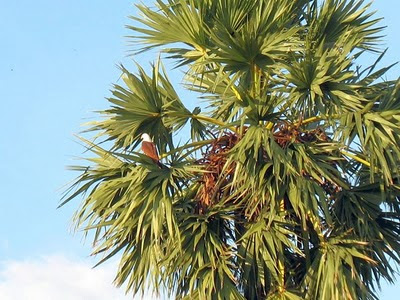


Using his perch as a lookout


A Brahminy Kite with young


Beautiful


Brahminy Kites mate (November-December) on or near the nest which is generally located in tall trees. Although they do not share nesting trees, pairs may nest less than 100m apart. The nest is compact and made of twigs and sticks and often lined with dried mud. A first-time nest is usually thin, but as the pair reuse the site, the nest thickens. 2 eggs are laid, white with sparse red-brown blotches. Both parents raise the young.

The call of the Brahminy Kite is a thin mewing scream 'kweeaa' or 'kyeeer' usually while soaring. This bird which is very tolerant of humans, is an unfussy scavenger that can survive in a wide range of habitats. Although it is described as generally quiet, individuals which have been in constant or regular contact with humans tend to be noisier.


In flight


With feet pressed flat against its body


As the bird has a tendency to raid fish farms and steal chickens, it is sometimes regarded as a pest in other places in the world. In some S.E. Asia countries the bird, along with other types of Kite are hunted with the young taken for pets.


A juvenile Brahminy Kite


However in India the bird has great status due to its connection with Garuda. And its name i.e. Brahminy results from its association with the Indian God Vishnu.


A juvenile Brahminy Kite skimming
the water for food


29 May 2009

Golden Oriole

This bird’s name, Oriole was first used in English in the 18th century, and comes from the Latin "aureolus" golden. This bird is known as the Golden Oriole or (Eurasian) Golden Oriole.

Its nesting season extends from April to July. It builds a cup-like nest of grass and fibres, bound with cobweb in the fork of a leafy twig tree. The bird lays 2 or 3 eggs, spotted black or reddish brown. Both sexes share all domestic duties.


The Indian race Oriole (kundoo) differs from the European chiefly in that its black eye-streak extends behind the eye. The bird, which is the size of a Mynah, is bright golden with black in wings and tail, and a conspicuous black streak through the eye.


In the below photograph a female Oriole (kundoo) which is duller and greener than the male.


Female Kundoo


The kundoo is found singly or in pairs, among leafy trees in wooded country. The bird is found throughout India, excepting N.E. India and is not uncommon at Tiruvannamalai District.


Male Kundoo


European Oriole


30 March 2009

The Grey Heron

The Grey Heron (Ardea cinerea), is a wading bird of the heron family Ardeidae, native throughout temperate Europe and Asia and also parts of Africa. Its is both a migratory and resident bird depending upon the climate.

There are four subspecies of the Grey Heron, of which Ardea Cinerea Cinerea Linnareus (Tamil = Sambal Narai) is found in Tamil Nadu and Tiruvannamalai District.


This bird flies with steady wing beats with neck folded back and head drawn in between the shoulders and its long legs trailing behind. It’s a big bird with large wing span and has a comparatively lumbering take off.


This bird is the size of an Asian openbill stork. Its field characteristics is that of a lanky stork-like bird. It is ashy grey above with white crown and neck, greyish white below, with long slender S-shaped neck, narrow head, and pointed dagger bill.

There is currently a colony of Grey Herons residing on the reedy banks of Samudram Erie but they will undoubtedly fly off as the lake water recedes. Several years ago when the Samudram was stocked with fish, the migratory Grey Heron was found in large quantities throughout that season.


The Grey Heron wades into shallow water with neck craned and bill poised, or stands hunched up but alert waiting for a frog or fish to blunder within striking range.


Its nesting season in South India is November to March. Its nest is comprised of a twig platform with the central depression lined with grass. Built gregariously in trees, often amongst mixed heronries. It lays 3 to 6 eggs of deep sea-green colour. Both sexes share all domestic duties.


To view a selection of videos of the Grey Heron click this link here.